Pruning is a data compression technique in machine learning and search algorithms that reduces the size of decision trees by removing sections of the tree that are non-critical and redundant to classify instances. Pruning reduces the complexity of the final classifier, and hence improves predictive accuracy by the reduction of overfitting. One of the questions that arises in a decision tree algorithm is the optimal size of the final tree. A tree that is too large risks overfitting the training data and poorly generalizing to new samples. A small tree might not capture important structural information about the sample space. However, it is hard to tell when a tree algorithm should stop because it is impossible to tell if the addition of a single extra node will dramatically decrease error. This problem is known as the horizon effect. A common strategy is to grow the tree until each node contains a small number of instances then use pruning to remove nodes that do not provide additional information. Pruning should reduce the size of a learning tree without reducing predictive accuracy as measured by a cross-validation set. There are many techniques for tree pruning that differ in the measurement that is used to optimize performance. == Techniques == Pruning processes can be divided into two types (pre- and post-pruning). Pre-pruning procedures prevent a complete induction of the training set by replacing a stop () criterion in the induction algorithm (e.g. max. Tree depth or information gain (Attr)> minGain). Pre-pruning methods are considered to be more efficient because they do not induce an entire set, but rather trees remain small from the start. Prepruning methods share a common problem, the horizon effect. This is to be understood as the undesired premature termination of the induction by the stop () criterion. Post-pruning (or just pruning) is the most common way of simplifying trees. Here, nodes and subtrees are replaced with leaves to reduce complexity. Pruning can not only significantly reduce the size but also improve the classification accuracy of unseen objects. It may be the case that the accuracy of the assignment on the train set deteriorates, but the accuracy of the classification properties of the tree increases overall. The procedures are differentiated on the basis of their approach in the tree (top-down or bottom-up). === Bottom-up pruning === These procedures start at the last node in the tree (the lowest point). Following recursively upwards, they determine the relevance of each individual node. If the relevance for the classification is not given, the node is dropped or replaced by a leaf. The advantage is that no relevant sub-trees can be lost with this method. These methods include Reduced Error Pruning (REP), Minimum Cost Complexity Pruning (MCCP), or Minimum Error Pruning (MEP). === Top-down pruning === In contrast to the bottom-up method, this method starts at the root of the tree. Following the structure below, a relevance check is carried out which decides whether a node is relevant for the classification of all n items or not. By pruning the tree at an inner node, it can happen that an entire sub-tree (regardless of its relevance) is dropped. One of these representatives is pessimistic error pruning (PEP), which brings quite good results with unseen items. == Pruning algorithms == === Reduced error pruning === One of the simplest forms of pruning is reduced error pruning. Starting at the leaves, each node is replaced with its most popular class. If the prediction accuracy is not affected then the change is kept. While somewhat naive, reduced error pruning has the advantage of simplicity and speed. === Cost complexity pruning === Cost complexity pruning generates a series of trees T 0 … T m {\displaystyle T_{0}\dots T_{m}} where T 0 {\displaystyle T_{0}} is the initial tree and T m {\displaystyle T_{m}} is the root alone. At step i {\displaystyle i} , the tree is created by removing a subtree from tree i − 1 {\displaystyle i-1} and replacing it with a leaf node with value chosen as in the tree building algorithm. The subtree that is removed is chosen as follows: Define the error rate of tree T {\displaystyle T} over data set S {\displaystyle S} as err ( T , S ) {\displaystyle \operatorname {err} (T,S)} . The subtree t {\displaystyle t} that minimizes err ( prune ( T , t ) , S ) − err ( T , S ) | leaves ( T ) | − | leaves ( prune ( T , t ) ) | {\displaystyle {\frac {\operatorname {err} (\operatorname {prune} (T,t),S)-\operatorname {err} (T,S)}{\left\vert \operatorname {leaves} (T)\right\vert -\left\vert \operatorname {leaves} (\operatorname {prune} (T,t))\right\vert }}} is chosen for removal. The function prune ( T , t ) {\displaystyle \operatorname {prune} (T,t)} defines the tree obtained by pruning the subtrees t {\displaystyle t} from the tree T {\displaystyle T} . Once the series of trees has been created, the best tree is chosen by generalized accuracy as measured by a training set or cross-validation. == Examples == Pruning could be applied in a compression scheme of a learning algorithm to remove the redundant details without compromising the model's performances. In neural networks, pruning removes entire neurons or layers of neurons.
Developmental robotics
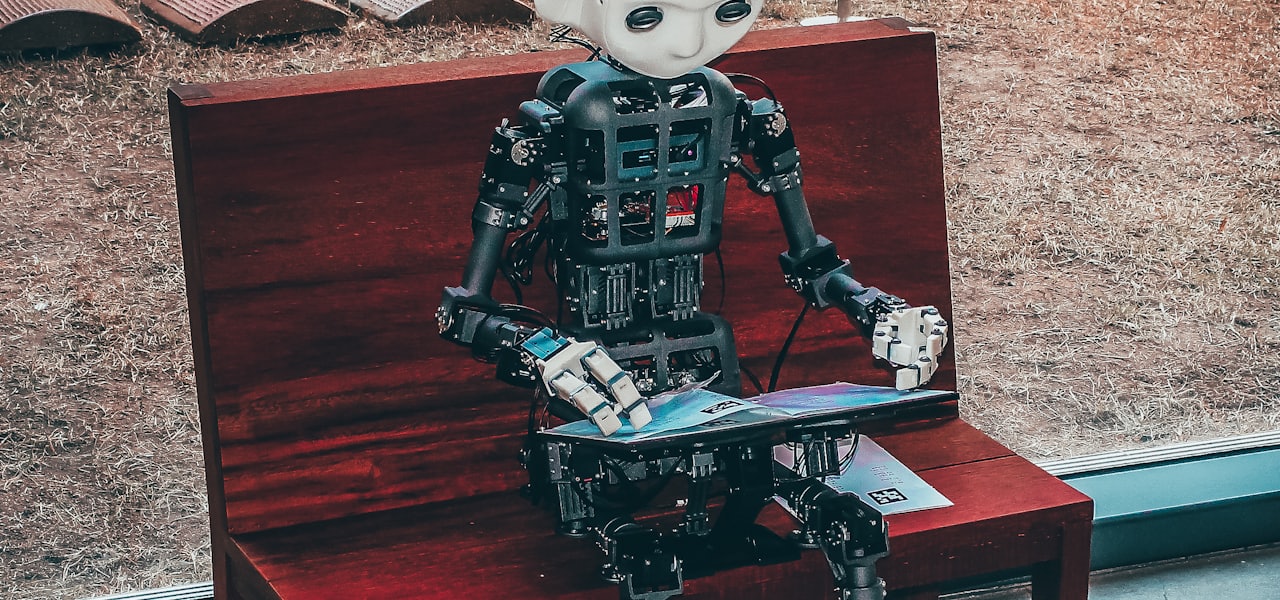
Developmental robotics (DevRob), sometimes called epigenetic robotics, is a scientific field which aims at studying the developmental mechanisms, architectures and constraints that allow lifelong and open-ended learning of new skills and new knowledge in embodied machines. As in human children, learning is expected to be cumulative and of progressively increasing complexity, and to result from self-exploration of the world in combination with social interaction. The typical methodological approach consists in starting from theories of human and animal development elaborated in fields such as developmental psychology, neuroscience, developmental and evolutionary biology, and linguistics, then to formalize and implement them in robots, sometimes exploring extensions or variants of them. The experimentation of those models in robots allows researchers to confront them with reality, and as a consequence, developmental robotics also provides feedback and novel hypotheses on theories of human and animal development. Developmental robotics is related to but differs from evolutionary robotics (ER). ER uses populations of robots that evolve over time, whereas DevRob is interested in how the organization of a single robot's control system develops through experience, over time. DevRob is also related to work done in the domains of robotics and artificial life. == Background == Can a robot learn like a child? Can it learn a variety of new skills and new knowledge unspecified at design time and in a partially unknown and changing environment? How can it discover its body and its relationships with the physical and social environment? How can its cognitive capacities continuously develop without the intervention of an engineer once it is "out of the factory"? What can it learn through natural social interactions with humans? These are the questions at the center of developmental robotics. Alan Turing, as well as a number of other pioneers of cybernetics, already formulated those questions and the general approach in 1950, but it is only since the end of the 20th century that they began to be investigated systematically. Because the concept of adaptive intelligent machines is central to developmental robotics, it has relationships with fields such as artificial intelligence, machine learning, cognitive robotics or computational neuroscience. Yet, while it may reuse some of the techniques elaborated in these fields, it differs from them from many perspectives. It differs from classical artificial intelligence because it does not assume the capability of advanced symbolic reasoning and focuses on embodied and situated sensorimotor and social skills rather than on abstract symbolic problems. It differs from cognitive robotics because it focuses on the processes that allow the formation of cognitive capabilities rather than these capabilities themselves. It differs from computational neuroscience because it focuses on functional modeling of integrated architectures of development and learning. More generally, developmental robotics is uniquely characterized by the following three features: It targets task-independent architectures and learning mechanisms, i.e. the machine/robot has to be able to learn new tasks that are unknown by the engineer; It emphasizes open-ended development and lifelong learning, i.e. the capacity of an organism to acquire continuously novel skills. This should not be understood as a capacity for learning "anything" or even “everything”, but just that the set of skills that is acquired can be infinitely extended at least in some (not all) directions; The complexity of acquired knowledge and skills shall increase (and the increase be controlled) progressively. Developmental robotics emerged at the crossroads of several research communities including embodied artificial intelligence, enactive and dynamical systems cognitive science, connectionism. Starting from the essential idea that learning and development happen as the self-organized result of the dynamical interactions among brains, bodies and their physical and social environment, and trying to understand how this self-organization can be harnessed to provide task-independent lifelong learning of skills of increasing complexity, developmental robotics strongly interacts with fields such as developmental psychology, developmental and cognitive neuroscience, developmental biology (embryology), evolutionary biology, and cognitive linguistics. As many of the theories coming from these sciences are verbal and/or descriptive, this implies a crucial formalization and computational modeling activity in developmental robotics. These computational models are then not only used as ways to explore how to build more versatile and adaptive machines but also as a way to evaluate their coherence and possibly explore alternative explanations for understanding biological development. == Research directions == === Skill domains === Due to the general approach and methodology, developmental robotics projects typically focus on having robots develop the same types of skills as human infants. A first category that is important being investigated is the acquisition of sensorimotor skills. These include the discovery of one's own body, including its structure and dynamics such as hand-eye coordination, locomotion, and interaction with objects as well as tool use, with a particular focus on the discovery and learning of affordances. A second category of skills targeted by developmental robots are social and linguistic skills: the acquisition of simple social behavioural games such as turn-taking, coordinated interaction, lexicons, syntax and grammar, and the grounding of these linguistic skills into sensorimotor skills (sometimes referred as symbol grounding). In parallel, the acquisition of associated cognitive skills are being investigated such as the emergence of the self/non-self distinction, the development of attentional capabilities, of categorization systems and higher-level representations of affordances or social constructs, of the emergence of values, empathy, or theories of mind. === Mechanisms and constraints === The sensorimotor and social spaces in which humans and robot live are so large and complex that only a small part of potentially learnable skills can actually be explored and learnt within a life-time. Thus, mechanisms and constraints are necessary to guide developmental organisms in their development and control of the growth of complexity. There are several important families of these guiding mechanisms and constraints which are studied in developmental robotics, all inspired by human development: Motivational systems, generating internal reward signals that drive exploration and learning, which can be of two main types: extrinsic motivations push robots/organisms to maintain basic specific internal properties such as food and water level, physical integrity, or light (e.g. in phototropic systems); intrinsic motivations push robot to search for novelty, challenge, compression or learning progress per se, thus generating what is sometimes called curiosity-driven learning and exploration, or alternatively active learning and exploration; Social guidance: as humans learn a lot by interacting with their peers, developmental robotics investigates mechanisms that can allow robots to participate to human-like social interaction. By perceiving and interpreting social cues, this may allow robots both to learn from humans (through diverse means such as imitation, emulation, stimulus enhancement, demonstration, etc. ...) and to trigger natural human pedagogy. Thus, social acceptance of developmental robots is also investigated; Statistical inference biases and cumulative knowledge/skill reuse: biases characterizing both representations/encodings and inference mechanisms can typically allow considerable improvement of the efficiency of learning and are thus studied. Related to this, mechanisms allowing to infer new knowledge and acquire new skills by reusing previously learnt structures is also an essential field of study; The properties of embodiment, including geometry, materials, or innate motor primitives/synergies often encoded as dynamical systems, can considerably simplify the acquisition of sensorimotor or social skills, and is sometimes referred as morphological computation. The interaction of these constraints with other constraints is an important axis of investigation; Maturational constraints: In human infants, both the body and the neural system grow progressively, rather than being full-fledged already at birth. This implies, for example, that new degrees of freedom, as well as increases of the volume and resolution of available sensorimotor signals, may appear as learning and development unfold. Transposing these mechanisms in developmental robots, and understanding how it may hinder or on the contrary ease the acquisition of novel complex skills is a central questi
Structured support vector machine
The structured supportvector machine is a machine learning algorithm that generalizes the support vector machine (SVM) classifier. Whereas the SVM classifier supports binary classification, multiclass classification and regression, the structured SVM allows training of a classifier for general structured output labels. As an example, a sample instance might be a natural language sentence, and the output label is an annotated parse tree. Training a classifier consists of showing pairs of correct sample and output label pairs. After training, the structured SVM model allows one to predict for new sample instances the corresponding output label; that is, given a natural language sentence, the classifier can produce the most likely parse tree. == Training == For a set of n {\displaystyle n} training instances ( x i , y i ) ∈ X × Y {\displaystyle ({\boldsymbol {x}}_{i},y_{i})\in {\mathcal {X}}\times {\mathcal {Y}}} , i = 1 , … , n {\displaystyle i=1,\dots ,n} from a sample space X {\displaystyle {\mathcal {X}}} and label space Y {\displaystyle {\mathcal {Y}}} , the structured SVM minimizes the following regularized risk function. min w ‖ w ‖ 2 + C ∑ i = 1 n max y ∈ Y ( 0 , Δ ( y i , y ) + ⟨ w , Ψ ( x i , y ) ⟩ − ⟨ w , Ψ ( x i , y i ) ⟩ ) {\displaystyle {\underset {\boldsymbol {w}}{\min }}\quad \|{\boldsymbol {w}}\|^{2}+C\sum _{i=1}^{n}{\underset {y\in {\mathcal {Y}}}{\max }}\left(0,\Delta (y_{i},y)+\langle {\boldsymbol {w}},\Psi ({\boldsymbol {x}}_{i},y)\rangle -\langle {\boldsymbol {w}},\Psi ({\boldsymbol {x}}_{i},y_{i})\rangle \right)} The function is convex in w {\displaystyle {\boldsymbol {w}}} because the maximum of a set of affine functions is convex. The function Δ : Y × Y → R + {\displaystyle \Delta :{\mathcal {Y}}\times {\mathcal {Y}}\to \mathbb {R} _{+}} measures a distance in label space and is an arbitrary function (not necessarily a metric) satisfying Δ ( y , z ) ≥ 0 {\displaystyle \Delta (y,z)\geq 0} and Δ ( y , y ) = 0 ∀ y , z ∈ Y {\displaystyle \Delta (y,y)=0\;\;\forall y,z\in {\mathcal {Y}}} . The function Ψ : X × Y → R d {\displaystyle \Psi :{\mathcal {X}}\times {\mathcal {Y}}\to \mathbb {R} ^{d}} is a feature function, extracting some feature vector from a given sample and label. The design of this function depends very much on the application. Because the regularized risk function above is non-differentiable, it is often reformulated in terms of a quadratic program by introducing one slack variable ξ i {\displaystyle \xi _{i}} for each sample, each representing the value of the maximum. The standard structured SVM primal formulation is given as follows. min w , ξ ‖ w ‖ 2 + C ∑ i = 1 n ξ i s.t. ⟨ w , Ψ ( x i , y i ) ⟩ − ⟨ w , Ψ ( x i , y ) ⟩ + ξ i ≥ Δ ( y i , y ) , i = 1 , … , n , ∀ y ∈ Y {\displaystyle {\begin{array}{cl}{\underset {{\boldsymbol {w}},{\boldsymbol {\xi }}}{\min }}&\|{\boldsymbol {w}}\|^{2}+C\sum _{i=1}^{n}\xi _{i}\\{\textrm {s.t.}}&\langle {\boldsymbol {w}},\Psi ({\boldsymbol {x}}_{i},y_{i})\rangle -\langle {\boldsymbol {w}},\Psi ({\boldsymbol {x}}_{i},y)\rangle +\xi _{i}\geq \Delta (y_{i},y),\qquad i=1,\dots ,n,\quad \forall y\in {\mathcal {Y}}\end{array}}} == Inference == At test time, only a sample x ∈ X {\displaystyle {\boldsymbol {x}}\in {\mathcal {X}}} is known, and a prediction function f : X → Y {\displaystyle f:{\mathcal {X}}\to {\mathcal {Y}}} maps it to a predicted label from the label space Y {\displaystyle {\mathcal {Y}}} . For structured SVMs, given the vector w {\displaystyle {\boldsymbol {w}}} obtained from training, the prediction function is the following. f ( x ) = argmax y ∈ Y ⟨ w , Ψ ( x , y ) ⟩ {\displaystyle f({\boldsymbol {x}})={\underset {y\in {\mathcal {Y}}}{\textrm {argmax}}}\quad \langle {\boldsymbol {w}},\Psi ({\boldsymbol {x}},y)\rangle } Therefore, the maximizer over the label space is the predicted label. Solving for this maximizer is the so-called inference problem and similar to making a maximum a-posteriori (MAP) prediction in probabilistic models. Depending on the structure of the function Ψ {\displaystyle \Psi } , solving for the maximizer can be a hard problem. == Separation == The above quadratic program involves a very large, possibly infinite number of linear inequality constraints. In general, the number of inequalities is too large to be optimized over explicitly. Instead the problem is solved by using delayed constraint generation where only a finite and small subset of the constraints is used. Optimizing over a subset of the constraints enlarges the feasible set and will yield a solution that provides a lower bound on the objective. To test whether the solution w {\displaystyle {\boldsymbol {w}}} violates constraints of the complete set inequalities, a separation problem needs to be solved. As the inequalities decompose over the samples, for each sample ( x i , y i ) {\displaystyle ({\boldsymbol {x}}_{i},y_{i})} the following problem needs to be solved. y n ∗ = argmax y ∈ Y ( Δ ( y i , y ) + ⟨ w , Ψ ( x i , y ) ⟩ − ⟨ w , Ψ ( x i , y i ) ⟩ − ξ i ) {\displaystyle y_{n}^{}={\underset {y\in {\mathcal {Y}}}{\textrm {argmax}}}\left(\Delta (y_{i},y)+\langle {\boldsymbol {w}},\Psi ({\boldsymbol {x}}_{i},y)\rangle -\langle {\boldsymbol {w}},\Psi ({\boldsymbol {x}}_{i},y_{i})\rangle -\xi _{i}\right)} The right hand side objective to be maximized is composed of the constant − ⟨ w , Ψ ( x i , y i ) ⟩ − ξ i {\displaystyle -\langle {\boldsymbol {w}},\Psi ({\boldsymbol {x}}_{i},y_{i})\rangle -\xi _{i}} and a term dependent on the variables optimized over, namely Δ ( y i , y ) + ⟨ w , Ψ ( x i , y ) ⟩ {\displaystyle \Delta (y_{i},y)+\langle {\boldsymbol {w}},\Psi ({\boldsymbol {x}}_{i},y)\rangle } . If the achieved right hand side objective is smaller or equal to zero, no violated constraints for this sample exist. If it is strictly larger than zero, the most violated constraint with respect to this sample has been identified. The problem is enlarged by this constraint and resolved. The process continues until no violated inequalities can be identified. If the constants are dropped from the above problem, we obtain the following problem to be solved. y i ∗ = argmax y ∈ Y ( Δ ( y i , y ) + ⟨ w , Ψ ( x i , y ) ⟩ ) {\displaystyle y_{i}^{}={\underset {y\in {\mathcal {Y}}}{\textrm {argmax}}}\left(\Delta (y_{i},y)+\langle {\boldsymbol {w}},\Psi ({\boldsymbol {x}}_{i},y)\rangle \right)} This problem looks very similar to the inference problem. The only difference is the addition of the term Δ ( y i , y ) {\displaystyle \Delta (y_{i},y)} . Most often, it is chosen such that it has a natural decomposition in label space. In that case, the influence of Δ {\displaystyle \Delta } can be encoded into the inference problem and solving for the most violating constraint is equivalent to solving the inference problem.
Best AI Pair Programmers in 2026
Shopping for the best AI pair programmer? An AI pair programmer is software that uses machine learning to help you get more done — it keeps getting smarter as the underlying models improve. Pricing, accuracy, and the size of the model behind the tool are the three factors that most affect daily usefulness. Whether you are a beginner or a pro, the right AI pair programmer slots into your workflow and pays for itself fast. Below we compare features, pricing, and real output so you can choose with confidence.
Alexei A. Efros
Alexei "Alyosha" A. Efros (born 9 April 1975) is a Russian-American computer scientist and professor at University of California, Berkeley. He has contributed to the field of computer vision, and his work has been referenced in Wired, BBC News, The New York Times, and The New Yorker. == Early life and education == Efros was born in St. Petersburg in the Soviet Union. His father is Alexei L. Efros, then a physics professor at the Ioffe Physico-Technical Institute. His family emigrated to the United States when he was 14 to accommodate his father's career and the family settled in Salt Lake City in 1991. He graduated from the University of Utah in 1997, and attended University of California, Berkeley for his PhD, where he was advised by Jitendra Malik and graduated in 2003. He then spent a year as a research fellow at the University of Oxford, where he worked with Andrew Zisserman. == Career == Efros joined the faculty at Carnegie Mellon University in Pittsburgh, where he remained until 2013 when he joined the faculty of the University of California, Berkeley. He received a Guggenheim Fellowship in 2008. He received the 2016 ACM Prize in Computing.
Document-oriented database
A document-oriented database, or document store, is a computer program and data storage system designed for storing, retrieving, and managing document-oriented information, also known as semi-structured data. Document-oriented databases are one of the main categories of NoSQL databases, and the popularity of the term "document-oriented database" has grown alongside the adoption of NoSQL itself. XML databases are a subclass of document-oriented databases optimized for XML documents. Graph databases are similar, but add another layer, the relationship, which allows them to link documents for rapid traversal. Document-oriented databases are conceptually an extension of the key–value store, another type of NoSQL database. In key-value stores, data is treated as opaque by the database, whereas document-oriented systems exploit the internal structure of documents to extract metadata and optimize storage and queries. Although in practice the distinction can be minimal due to modern tooling, document stores are designed to provide a richer programming experience with modern programming techniques. Document databases differ significantly from traditional relational databases (RDBs). Relational databases store data in predefined tables, often requiring an object to be split across multiple tables. In contrast, document databases store all information for a given object in a single document, with each document potentially having a unique structure. This design eliminates the need for object-relational mapping when loading data into the database. == Documents == The central concept of a document-oriented database is the notion of a document. Although implementations vary in their specific definitions, document-oriented databases generally treat documents as self-contained units that encapsulate and encode data in a standardized format. Common encoding formats include XML, YAML, JSON, as well as binary representations such as BSON. Documents in a document store are equivalent to the programming concept of an object. They are not required to adhere to a fixed schema, and documents within the same collection may contain different fields or structures. Fields may be optional, and documents of the same logical type may differ in composition. For example, the following illustrates a document encoded in JSON: A second document might be encoded in XML as: The two example documents share some structural elements but also contain unique fields. The structure, text, and other data within each document are collectively referred to as the document's content and can be accessed or modified using retrieval or editing operations. Unlike relational databases, in which each record contains the same fields and unused fields are left empty, document-oriented databases do not require uniform fields across documents. This design allows new information to be added to some documents without affecting the structure of others. Document databases often support the storage of additional metadata alongside the document content. Such metadata may relate to organizational features, security, indexing, or other implementation-specific features. === CRUD operations === The core operations supported by a document-oriented database for manipulating documents are similar to those in other databases. Although terminology is not perfectly standardized, these operations are generally recognized as Create, Read, Update, and Delete (CRUD). Creation (C): Adds a new document to the database. Retrieval (R): Retrieves documents or fields based on queries. Update (U): Modifies the contents of existing documents. Deletion (D): Removes documents from the database. === Keys === Documents in a document-oriented database are addressed via a unique identifier. This identifier, often a string, URI, or path, can be used to retrieve the document from the database. Most document stores maintain an index on the key to optimize retrieval, and in some implementations the key is required when creating or inserting a new document. === Retrieval === In addition to key-based access, document-oriented databases typically provide an API or query language that enables retrieval based on document content or associated metadata. For example, a query may return all documents with a specific field matching a given value. The available query features, indexing options, and performance characteristics vary across implementations. Document stores differ from key-value stores in that they exploit the internal structure and metadata of stored documents. In many key-value stores, values are treated as opaque or "black-box" data, meaning the database system does not interpret their internal structure. By contrast, document-oriented databases can classify and interpret document content. This enables queries that distinguish between types of data––for example, retrieving all phone numbers containing "555" without also matching a postal code such as "55555." === Editing === Document databases typically provide mechanisms for updating or editing the content or metadata of a document. Updates may involve replacing the entire document or modifying individual elements or fields within the document. === Organization === Document database implementations support a variety of methods for organizing documents, including: Collections: Groups of documents. Depending on the implementation, a document may be required to belong to a single collection or may be allowed in multiple collections. Tags and non-visible metadata: Additional data stored outside the main document content. Directory hierarchies: Documents organized in a tree-like structure, often based on path or URI. These organizational structures may differ between logical and physical representations (e.g. on disk or in memory). == Relationship to other databases == === Relationship to key-value stores === A document-oriented database can be viewed as a specialized form of key-value store, which is itself a category of NoSQL database. In a basic key-value store, the stored value is typically treated as opaque by the database system. By contrast, a document-oriented database provides APIs or a query and update language that allows queries and modifications based on the internal structure of the document. For users who do not require advanced query, retrieval, or update capabilities, the distinction between document-oriented databases and key-value stores may be minimal. === Relationship to search engines === Some search engine and information retrieval systems, such as Apache Solr and Elasticsearch, provide document storage and support core document operations. As a result, they may meet certain functional definitions of a document-oriented database, although their primary design goals differ. === Relationship to relational databases === In a relational database, data is organized into predefined types represented as tables. Each table contains rows (records) with a fixed set of columns (fields), so all records in a table share the same structure. Administrators typically define indexes on selected fields to improve query performance. A central principle of relational database design is database normalization, in which data that might otherwise be repeated is stored in separate tables and linked using keys. When records in different tables are related, a foreign key is used to associate them. For example, an address book application may store a contact's name, image, phone numbers, mailing addresses, and email addresses. In a normalized relational design, separate tables might be created for contacts, phone numbers, and email addresses. The phone number table would include a foreign key referencing the associated contact. To reconstruct a complete contact record, the database retrieves related information from each table using the foreign keys and combines it into a single record. In contrast, a document-oriented database stores all data related to an object within a single document, and stored in the database as a single entry. In the address book example,the contact's name, image, and contact information may be stored together in one document. The document is retrieved using a unique key, and all related information is returned together, without needing to look up multiple tables. A key difference between the document-oriented and relational models is that the data formats are not predefined in the document case. In most cases, any sort of document can be stored in a database, and documents can change in type and form over time. For example, a new field such as COUNTRY_FLAG can be added to new documents as they are inserted without affecting existing documents. To aid retrieval, document-oriented systems generally allow the administrator to provide hints to the database for locating certain types of information. These hints work in a similar fashion to indexes in relational databases. Many systems also allow additional metadata outside the content of the document itself
P4-metric
The P4 metric (also known as FS or Symmetric F ) enables performance evaluation of a binary classifier. The P4 metric is calculated from precision, recall, specificity, and NPV (negative predictive value). The definition of the P4 metric is similar to that of the F1 metric, however the P4 metric definition addresses criticisms leveled against the definition of the F1 metric. The definition of the P4 metric may, therefore, be understood as an extension of the F1 metric. Like the other known metrics, the P4 metric is a function of: TP (true positives), TN (true negatives), FP (false positives), FN (false negatives). == Justification == The key concept of the P4 metric is to leverage the four key conditional probabilities: P ( + ∣ C + ) {\displaystyle P(+\mid C{+})} — the probability that the sample is positive, provided the classifier result was positive. P ( C + ∣ + ) {\displaystyle P(C{+}\mid +)} — the probability that the classifier result will be positive, provided the sample is positive. P ( C − ∣ − ) {\displaystyle P(C{-}\mid -)} — the probability that the classifier result will be negative, provided the sample is negative. P ( − ∣ C − ) {\displaystyle P(-\mid C{-})} — the probability the sample is negative, provided the classifier result was negative. The main assumption behind this metric is that all the probabilities mentioned above are close to 1 for a properly designed binary classifier. Indeed, P 4 = 1 {\displaystyle \mathrm {P} _{4}=1} if, and only if, all of the probabilities above are equal to 1. Another important feature is that P 4 {\displaystyle \mathrm {P} _{4}} tends to zero any of the above probabilities tend to zero. == Definition == P4 is defined as a harmonic mean of four key conditional probabilities: P 4 = 4 1 P ( + ∣ C + ) + 1 P ( C + ∣ + ) + 1 P ( C − ∣ − ) + 1 P ( − ∣ C − ) = 4 1 p r e c i s i o n + 1 r e c a l l + 1 s p e c i f i c i t y + 1 N P V . {\displaystyle \mathrm {P} _{4}={\frac {4}{{\frac {1}{P(+\mid C{+})}}+{\frac {1}{P(C{+}\mid +)}}+{\frac {1}{P(C{-}\mid -)}}+{\frac {1}{P(-\mid C{-})}}}}={\frac {4}{{\frac {1}{\mathit {precision}}}+{\frac {1}{\mathit {recall}}}+{\frac {1}{\mathit {specificity}}}+{\frac {1}{\mathit {NPV}}}}}.} In terms of TP,TN,FP,FN it can be calculated as follows: P 4 = 4 ⋅ T P ⋅ T N 4 ⋅ T P ⋅ T N + ( T P + T N ) ⋅ ( F P + F N ) . {\displaystyle \mathrm {P} _{4}={\frac {4\cdot \mathrm {TP} \cdot \mathrm {TN} }{4\cdot \mathrm {TP} \cdot \mathrm {TN} +(\mathrm {TP} +\mathrm {TN} )\cdot (\mathrm {FP} +\mathrm {FN} )}}.} == Evaluation of the binary classifier performance == Evaluating the performance of binary classifiers is a multidisciplinary concept. It spans from the evaluation of medical tests, psychiatric tests to machine learning classifiers from a variety of fields. Thus, many of the metrics in use exist under several names, some defined independently. == Properties of P4 metric == Symmetry — contrasting to the F1 metric, P4 is symmetrical. It means - it does not change its value when dataset labeling is changed - positives named negatives and negatives named positives. Range: P 4 ∈ [ 0 , 1 ] {\displaystyle \mathrm {P} _{4}\in [0,1]} . Achieving P 4 ≈ 1 {\displaystyle \mathrm {P} _{4}\approx 1} requires all the key four conditional probabilities being close to 1. For P 4 ≈ 0 {\displaystyle \mathrm {P} _{4}\approx 0} it is sufficient that one of the key four conditional probabilities is close to 0. == Examples, comparing with the other metrics == Dependency table for selected metrics ("true" means depends, "false" - does not depend): Metrics that do not depend on a given probability are prone to misrepresentation when the probability approaches 0. === Example 1: Rare disease detection test === Let us consider a medical test used to detect a rare disease. Suppose a population size of 100000 and 0.05% of the population is infected. Further suppose the following test performance: 95% of all positive individuals are classified correctly (TPR=0.95) and 95% of all negative individuals are classified correctly (TNR=0.95). In such a case, due to high population imbalance and in spite of having high test accuracy (0.95), the probability that an individual who has been classified as positive is in fact positive is very low: P ( + ∣ C + ) = 0.0095. {\displaystyle P(+\mid C{+})=0.0095.} We can observe how this low probability is reflected in some of the metrics: P 4 = 0.0370 {\displaystyle \mathrm {P} _{4}=0.0370} , F 1 = 0.0188 {\displaystyle \mathrm {F} _{1}=0.0188} , J = 0.9100 {\displaystyle \mathrm {J} =\mathbf {0.9100} } (Informedness / Youden index), M K = 0.0095 {\displaystyle \mathrm {MK} =0.0095} (Markedness). === Example 2: Image recognition — cats vs dogs === Consider the problem of training a neural network based image classifier with only two types of images: those containing dogs (labeled as 0) and those containing cats (labeled as 1). Thus, the goal is to distinguish between the cats and dogs. Suppose that the classifier overpredicts in favour of cats ("positive" samples): 99.99% of cats are classified correctly and only 1% of dogs are classified correctly. Further, suppose that the image dataset consists of 100000 images, 90% of which are pictures of cats and 10% are pictures of dogs. In this situation, the probability that the picture containing dog will be classified correctly is pretty low: P ( C − | − ) = 0.01. {\displaystyle P(C-|-)=0.01.} Not all metrics are notice this low probability: P 4 = 0.0388 {\displaystyle \mathrm {P} _{4}=0.0388} , F 1 = 0.9478 {\displaystyle \mathrm {F} _{1}=\mathbf {0.9478} } , J = 0.0099 {\displaystyle \mathrm {J} =0.0099} (Informedness / Youden index), M K = 0.8183 {\displaystyle \mathrm {MK} =\mathbf {0.8183} } (Markedness).